


Ask ChatGPT or Claude about today's weather and a status line appears: "Searching the web". It reads like the AI just opened a browser and went looking. It did not, and it cannot. The language model at the center of these products is incapable of opening a network connection, and understanding what actually happens during that status line changes how you read every AI product on the market.
A language model does exactly one thing
Strip away the chat interface and a large language model has a single capability: it reads text and it writes text. There is no browser inside it, no HTTP client, no network stack. It is a function that takes a conversation as input and produces the next chunk of text as output. That is the entire machine.
Which raises the obvious question. If the model can only write text, and its training data ended months ago, how does it tell you the current temperature in Amsterdam?
The application tells the model what tools exist
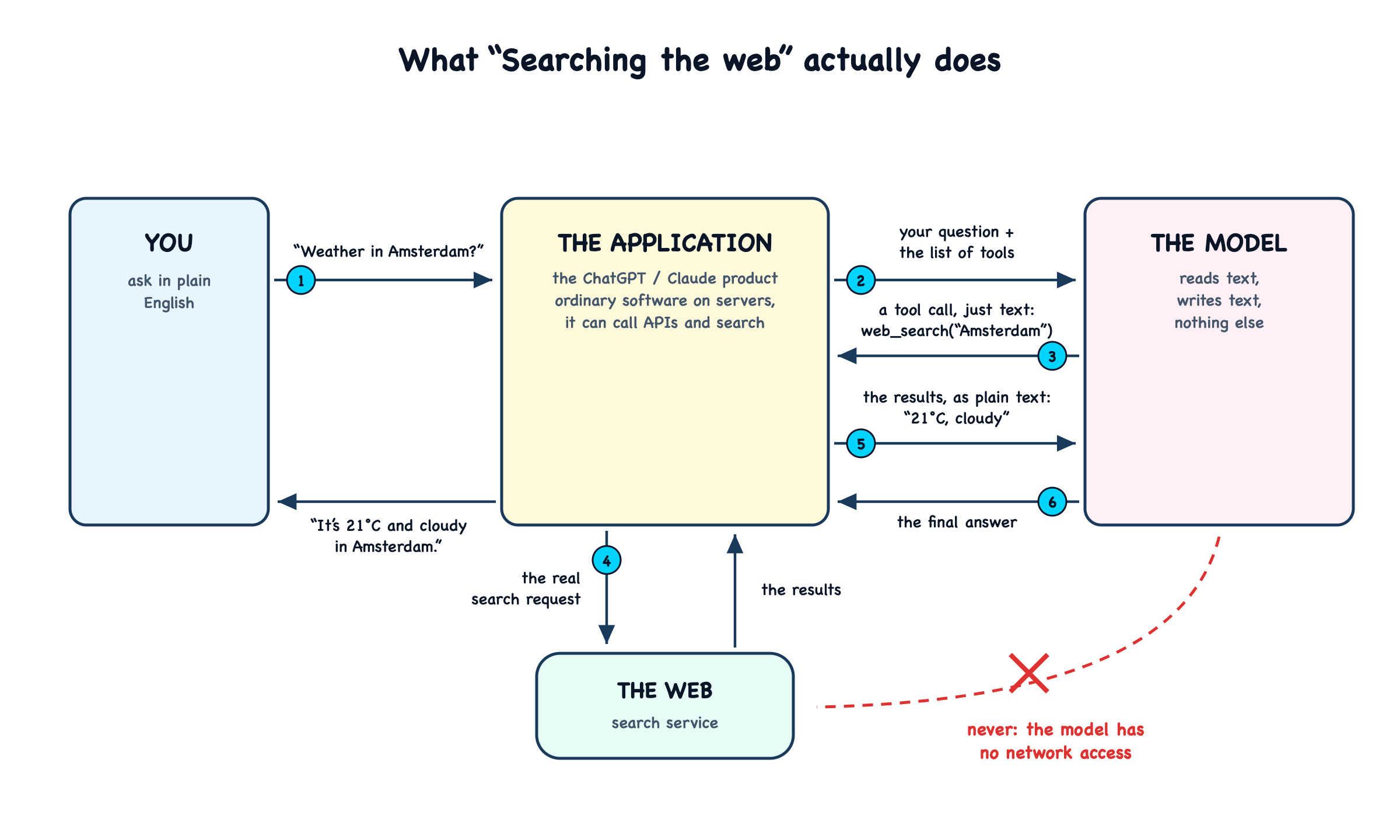
The answer starts before you type anything. When the application sends your message to the model, it attaches something extra: a list of tools the model is allowed to request, each with a name and a description. One of them is a web search tool. This mechanism is called tool calling (you will also see the older name, function calling), and it is a standard feature of the APIs that OpenAI, Anthropic, and other model providers expose.
So the model reading your Amsterdam question knows two things: it does not know the current weather, and a tool called web search is available. Its training taught it what to do with that combination.
The model asks, it does not act
Instead of answering, the model writes a small structured request, effectively a note that says: run web search with the query "Amsterdam weather right now". The note is formatted so software can parse it reliably, but it is still just text the model generated.
This is the step worth pausing on. At this moment, nothing has happened. No search has run, no connection has opened. The model has produced a request and stopped, the same way it produces any other output. If the surrounding software ignored that note, the story would end there.
The application does the real work
The note lands in the application's backend, which is ordinary software running on ordinary servers, perfectly capable of making API calls like any other program. It parses the model's request, runs the actual search against a real search service, and collects the results.
Then it does the translation step that makes the whole loop work: it converts those results into plain text and appends them to the conversation, as if a very fast assistant had pasted in research notes. The model now gets invoked again with the updated conversation, reads the fresh text, and does the one thing it is good at: it picks out what matters and writes you a clean answer. "It's currently 21°C and cloudy in Amsterdam."
The model never searched. It requested a search, then summarized what came back.
Why this distinction matters
This same division of labor sits under almost every AI product you touch: coding assistants that "read your files", agents that "manage your Kubernetes cluster", chatbots that "check your order status". In each case the model decides which tool to request and interprets the result, while the application executes the request with real code. An agent is simply this loop run repeatedly, a model choosing its next tool call after each result comes back.
Knowing that changes how you evaluate these products. When a vendor says their AI "does" something, the accurate question is: what tools did they give the model, and what does the application actually execute? It also explains failure modes. If an answer citing "search results" gets a detail wrong, the search may have been fine and the model's summary of it wrong, because everything you read still passes through text generation at the end.
The brain and hands metaphor holds up well: the model is the brain that decides what needs to happen, and the application is the hands that make it happen. Neither is useful alone, and the product you are using is always both.
FAQs
Q1: Can ChatGPT or Claude access the internet directly?
The model itself cannot; it only reads and writes text. The product around it can, and that is what runs searches, executes code, and calls APIs on the model's request. Whether a given product has web access depends on which tools its application layer provides, not on the model's abilities.
Q2: What is tool calling in one sentence?
Tool calling (or function calling) is the mechanism where an application describes available tools to a model, the model responds with a structured request to use one, and the application executes that request and returns the result as text.
Q3: Why does an AI sometimes say it cannot browse the web?
Because in that product, or that mode, no web tool was offered to the model. The model's honest description of itself ("I cannot browse the internet") is always true at the model level; products add the capability by wiring a search tool into the loop.





Discussion